RIXML is the XML schema published by the RIXML consortium for tagging the metadata that travels with a piece of investment research: asset class, sector, region, analyst, entitlements, embargoes. Sell-side firms publish research wrapped in it. Buy-side aggregators ingest it. Get the metadata wrong and the report can fail to show up in the views your clients are watching, often without anyone telling you.
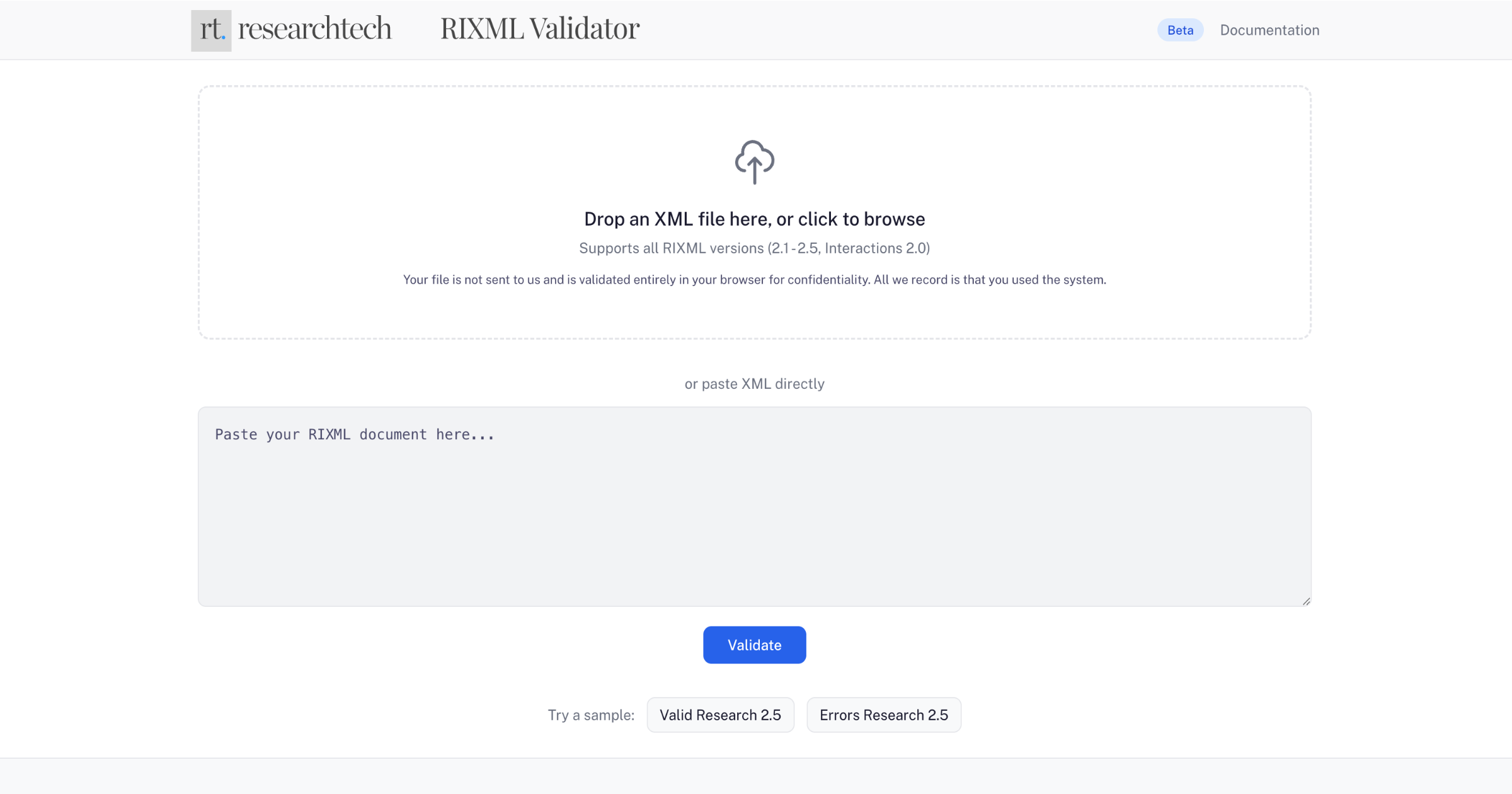
We built a free, browser-based RIXML validator so anyone in the industry can check a file in seconds without sending it to a server.
A research note travels from publisher to aggregators to analyst, wrapped in RIXML metadata.
What RIXML is
RIXML stands for Research Information Exchange Markup Language. It is the de facto industry standard for describing investment-research metadata, maintained by a consortium that includes buy-side firms, sell-side firms, and the larger distribution platforms.
When an analyst publishes a note, the firm wraps the document in a RIXML envelope: a short XML file that declares who wrote it, what it covers, who is allowed to read it, and how long it stays valid. Aggregators like Bloomberg, FactSet, and S&P Global read those tags to route the document and apply entitlements at their end. Without RIXML, large-scale research distribution would not work; there are simply too many publishers, platforms, and entitlement rules involved to coordinate them by hand.
Why validation matters
A RIXML file looks simple. It is a few hundred lines of XML. Most of the failure modes are not in the lines you would inspect first.
When a document fails validation, aggregators do not always tell you. Some reject the file loudly. Others drop it without notice, or strip it of attributes they cannot interpret, or downgrade it to a generic "research" entry that will not appear in the filtered views your clients are watching. The publisher's pipeline reports success and the buy-side analyst never sees the report.
Validated documents reach the analyst. Unchecked ones can disappear at the aggregator without anyone noticing.
There are a handful of common reasons a RIXML file ends up invalid. Schema-version drift is the usual one: firms upgrade their pipelines on different cadences, and generating a 2.5 file when the aggregator expects 2.4 (or the reverse) will fail. Hand-edited XML is another frequent culprit, where a quick Friday fix turns into a missing attribute, an unescaped ampersand, or a mismatched namespace. The subtler failures are the ones that pass XSD but break downstream. Some RIXML attributes are typed as opaque strings (security identifiers, entitlement codes, internal taxonomy tags) which the schema cannot validate beyond format. An ISIN that matches the 12-character pattern but does not reference a real instrument, or an entitlement code the receiving aggregator expects from its own controlled list, will pass XSD and still be rejected at the other end. Encoding is the last one to look at. UTF-8 BOMs, smart quotes, and non-breaking spaces are all routine if the document started life in Word or InDesign.
Validating before you publish catches most of these in seconds.
The gap we saw
The validators we found are not built for the people who most need to validate RIXML. Most of them sit behind a vendor login, locked inside a research-distribution platform you only have access to if you are already a paying customer. Some are command-line tools that need the schema files pulled down and a Java or Python toolchain configured. The general-purpose XML validators online expect you to upload your file to a server you have never heard of, which is acceptable for an open-source spec but a problem for embargoed pre-publication research.
There was no quick, free place to drag a RIXML file in and check whether it was valid, so we built one.
Browser-based vs server-side validators
| Browser-based (this tool) | Server-side / paywalled validators | |
|---|---|---|
| Cost | Free | Vendor login or paid licence |
| Privacy | File never leaves your browser | File uploaded to a remote server |
| Setup | Open the page | Install or log in |
| RIXML versions supported | Major versions handled by default | Whatever the vendor decided |
| Live re-validation | Yes, edit and revalidate inline | Re-upload each time |
| Offline use | Works once the page has loaded | No |
For pre-publication research, privacy is usually the deciding factor.
What our tool does
Open researchte.ch/rixml/validate and you can drag an .xml file onto the page, paste content into a textbox, or pick one of the bundled sample documents. The validator runs immediately and reports:
- schema-level errors (RIXML Level 0 / Level 1 conformance)
- code-list and semantic issues that XSD validation alone will not catch
- the exact line and column of every problem, with a click-through to the source
The XML opens in an in-browser Monaco editor (the same editor that runs in VS Code), so you can fix issues in place. Edits re-validate live with a short debounce, so iterating on a fix is fast.
Runs entirely in your browser
The validator runs client-side on the page you load. Your XML file never leaves your machine. Nothing is uploaded, the document is not processed on any server, and the page collects no telemetry on its contents. Once the page has loaded, the tool works offline; the validator and schema files are cached.
Your file and the validator stay inside the browser. No data crosses to a remote server.
That matters because the documents most worth validating are usually the ones you cannot share: pre-publication notes under embargo, draft templates, files containing client identifiers, or anything covered by an internal compliance policy on third-party tools.
It's free
The tool requires no signup, no login, and has no paywall. If you publish or ingest research and you want to know whether a file is valid, the tool is at researchte.ch/rixml/validate.
FAQ
What is RIXML?
RIXML is an XML schema published by the RIXML consortium for tagging investment-research metadata such as author, asset class, sector, region, entitlements, and embargoes. Sell-side firms publish research wrapped in it and buy-side aggregators ingest it.
Is RIXML validation free?
Yes. Our validator at researchte.ch/rixml/validate is completely free. There is no signup and no login.
Does my XML file get uploaded anywhere?
No. The validator runs entirely in your browser. Your file never leaves your machine. It works offline once the page has loaded.
Which RIXML versions are supported?
The tool supports the major RIXML schema versions in production use. The version of an uploaded file is detected automatically, and you can override it from the editor if needed.
Where can I read the RIXML spec?
The official specification, schema files, and documentation are published by the consortium at rixml.org.
This is one of several free RIXML tools we maintain. See also our RIXML documentation for an overview of the schema and its main element types.